While looking for some totally unrelated statistics on the ABS website I came across a feature article from the 1972 Tasmanian Yearbook about the Morris Miller Library.
Total budget for 1970: $414,787!
I like the section on future developments:
Establishment of a library branch in northern Tasmania, as an expansion of the present extension service, will be considered in the future but this is dependent on the expansion of the University’s northern facilities.
Initial steps have been taken to provide an audio-visual collection in the central library. Equipment is to be installed for playing disc and taped recordings, particularly music, both from a central control point and individual cassette-players.
Investigations have been made of the feasibility of automating some library routines but introduction of automated techniques is considered a doubtful economic and technical proposition at the present level of transactions.
More: http://www.abs.gov.au/AUSSTATS/abs@.nsf/Previousproducts/1384.6Feature%20Article122004?opendocument&tabname=Summary&prodno=1384.6&issue=2004&num=&view=
Wednesday, 21 July 2010

Monday, 19 July 2010
The end of the reference desk
From the blog of the McMaster University Librarian:
"After much planning and hard work the last of our reference desks is gone! Our library has completed the transition to “blended services” where library assistants handle most of the transactions at combined service points (circulation, interlibrary loan, research help). Our business library was the first to go in this direction around one year ago followed by our science/engineering library. Finally, I came in this morning to find that the last of our reference desks is now gone!"
http://ulatmac.blog.lib.mcmaster.ca/2010/07/15/reference-desk-gone/
Thursday, 15 July 2010
Proceedings of the 31st IATUL Conference now available
The link to the proceedings of the 31st IATUL Conference: The evolving world of e-science: Impact and implications of science and technology libraries held at Purdue University 21 - 24 June 2010 is available at http://www.iatul.org/conferences/pastconferences/
Wednesday, 14 July 2010
Top 50 librarian blogs
I've found this site which lists 50 librarian blogs. They are listed on the GetDegrees website. If you are looking for more ways to keep in touch with what is going on in Library Land it is worth exploring some of the links.
Friday, 9 July 2010
Top ten trends in academic libraries
The ACRL Research Planning and Review Committee developed a list of the top ten trends that are affecting academic libraries now and in the near future. This list was compiled based on an extensive review of current literature.
http://crln.acrl.org/content/71/6/286.short
http://crln.acrl.org/content/71/6/286.short
Thursday, 24 June 2010
Standardising and Measuring Graduate Abilities
Two large projects underway at the moment seem to indicate that quality of teaching may become increasingly important to regulators and universities.
The Australian Federal Government is introducing minimum standards for universities (and other bachelor degree providers) to develop in graduates in a project managed by ALTC discipline scholars. Standards are being developed in consultation with employers, professional bodies and higher education agencies on a discipline by discipline basis. In the Business area, Accounting standards are currently under discussion.
The standards will be administered by the Tertiary Education Quality and Standards Agency (TEQSA), which replaces the Australian University Qualities Agency (AUQA). More on TEQSA here: http://www.deewr.gov.au/HigherEducation/Policy/teqsa/Pages/Overview.aspx
And the Disciplines Setting Standards project here; http://www.altc.edu.au/standards/overview
The OECD currently measures the abilities of school leavers as a way to benchmark the performance of education systems among member countries, and now they are aiming to measure university graduate abilities in a project that may significantly change international ranking systems, now based on research outputs. The report in the Australian Higher education section gives more details about this:
http://www.theaustralian.com.au/higher-education/learning-is-as-simple-as-oecd/story-e6frgcjx-1225882950671
So where are libraries in all this? Are advocacy groups pushing for information literacy skills to be included as core graduate abilities by the ALTC? Will the OECD measure research skills or evaluation of information sources as core skills of graduates? If not, why not?
Monday, 21 June 2010
Closing the Digital Frontier
"The era of the Web browser’s dominance is coming to a close. And the Internet’s founding ideology—that information wants to be free, and that attempts to constrain it are not only hopeless but immoral— suddenly seems naive and stale in the new age of apps, smart phones, and pricing plans. What will this mean for the future of the media—and of the Web itself?"
A well considered piece in The Atlantic, dissecting the cultural underpinnings of the rise of the internet and framing the battle between Google and Apple in an interesting way. Michael Hirschorn connects the idea of "Manifest Destiny", to the pioneers of the internet as a social idea, utopians from West Coast USA who proposed using the network of copper cables laid around the world to expand consciousness and build a new kind of ecology of ideas and information.
Well worth a read.
http://www.theatlantic.com/magazine/archive/2010/07/closing-the-digital-frontier/8131/1/
Friday, 18 June 2010
Morris Miller Library: Renovations Progress
Staff were invited to a tour of the half finished renovations in the Morris Miller Library, they're running slightly behind schedule but progressing well.
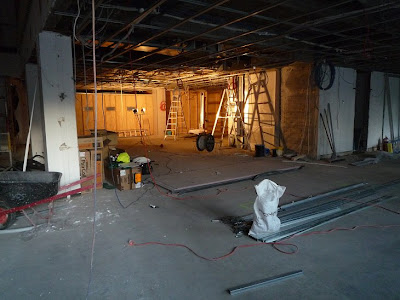
This will be the new students area, for computers, and the reference and reserve collections
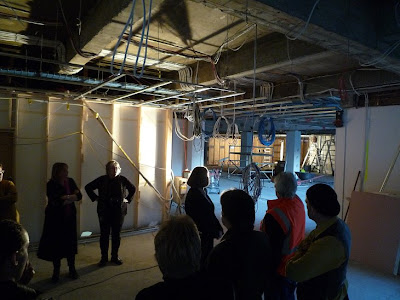
The entrance to the new staff area

The Morris Miller Librarian's Office
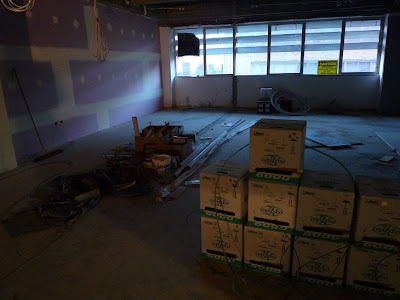
The new eLab 1, a combined teaching and student work space

The view from the Liaison Librarian's part of the new staff work area

This will be the new students area, for computers, and the reference and reserve collections

The entrance to the new staff area

The Morris Miller Librarian's Office

The new eLab 1, a combined teaching and student work space

The view from the Liaison Librarian's part of the new staff work area
Friday, 11 June 2010
Librarianship on iTunesU

I've been downloading a variety of stuff from iTunesU for a while, and it's just incredible what is available. Whole course lecture series from the world's great Universities, guest lecturers that are the top names in their fields and all kinds of other stuff, and all for free.
I only thought to look for librarianship content recently though, and while there's not as much as if you're interested in learning about some other subject areas, there is still enough content to keep you busy for quite a while.
For more on how to access iTunesU and what's available, check out the link below:
http://www.apple.com/education/itunes-u/whats-on.html
Tuesday, 25 May 2010
Rethink! Learning styles debunked
Rethink! Learning styles debunked
Latest research now contradicts long held beliefs about different learning styles and utilising them to create the best learning environment. Find out more about learning styles and see where you sit in this debate.
http://www.sciencedaily.com/releases/2009/12/091216162356.htm
Latest research now contradicts long held beliefs about different learning styles and utilising them to create the best learning environment. Find out more about learning styles and see where you sit in this debate.
http://www.sciencedaily.com/releases/2009/12/091216162356.htm
Subscribe to:
Posts (Atom)


