The ACRL Research Planning and Review Committee developed a list of the top ten trends that are affecting academic libraries now and in the near future. This list was compiled based on an extensive review of current literature.
http://crln.acrl.org/content/71/6/286.short
Friday, 9 July 2010

Thursday, 24 June 2010
Standardising and Measuring Graduate Abilities
Two large projects underway at the moment seem to indicate that quality of teaching may become increasingly important to regulators and universities.
The Australian Federal Government is introducing minimum standards for universities (and other bachelor degree providers) to develop in graduates in a project managed by ALTC discipline scholars. Standards are being developed in consultation with employers, professional bodies and higher education agencies on a discipline by discipline basis. In the Business area, Accounting standards are currently under discussion.
The standards will be administered by the Tertiary Education Quality and Standards Agency (TEQSA), which replaces the Australian University Qualities Agency (AUQA). More on TEQSA here: http://www.deewr.gov.au/HigherEducation/Policy/teqsa/Pages/Overview.aspx
And the Disciplines Setting Standards project here; http://www.altc.edu.au/standards/overview
The OECD currently measures the abilities of school leavers as a way to benchmark the performance of education systems among member countries, and now they are aiming to measure university graduate abilities in a project that may significantly change international ranking systems, now based on research outputs. The report in the Australian Higher education section gives more details about this:
http://www.theaustralian.com.au/higher-education/learning-is-as-simple-as-oecd/story-e6frgcjx-1225882950671
So where are libraries in all this? Are advocacy groups pushing for information literacy skills to be included as core graduate abilities by the ALTC? Will the OECD measure research skills or evaluation of information sources as core skills of graduates? If not, why not?
The Australian Federal Government is introducing minimum standards for universities (and other bachelor degree providers) to develop in graduates in a project managed by ALTC discipline scholars. Standards are being developed in consultation with employers, professional bodies and higher education agencies on a discipline by discipline basis. In the Business area, Accounting standards are currently under discussion.
The standards will be administered by the Tertiary Education Quality and Standards Agency (TEQSA), which replaces the Australian University Qualities Agency (AUQA). More on TEQSA here: http://www.deewr.gov.au/HigherEducation/Policy/teqsa/Pages/Overview.aspx
And the Disciplines Setting Standards project here; http://www.altc.edu.au/standards/overview
The OECD currently measures the abilities of school leavers as a way to benchmark the performance of education systems among member countries, and now they are aiming to measure university graduate abilities in a project that may significantly change international ranking systems, now based on research outputs. The report in the Australian Higher education section gives more details about this:
http://www.theaustralian.com.au/higher-education/learning-is-as-simple-as-oecd/story-e6frgcjx-1225882950671
So where are libraries in all this? Are advocacy groups pushing for information literacy skills to be included as core graduate abilities by the ALTC? Will the OECD measure research skills or evaluation of information sources as core skills of graduates? If not, why not?
Monday, 21 June 2010
Closing the Digital Frontier
"The era of the Web browser’s dominance is coming to a close. And the Internet’s founding ideology—that information wants to be free, and that attempts to constrain it are not only hopeless but immoral— suddenly seems naive and stale in the new age of apps, smart phones, and pricing plans. What will this mean for the future of the media—and of the Web itself?"
A well considered piece in The Atlantic, dissecting the cultural underpinnings of the rise of the internet and framing the battle between Google and Apple in an interesting way. Michael Hirschorn connects the idea of "Manifest Destiny", to the pioneers of the internet as a social idea, utopians from West Coast USA who proposed using the network of copper cables laid around the world to expand consciousness and build a new kind of ecology of ideas and information.
Well worth a read.
http://www.theatlantic.com/magazine/archive/2010/07/closing-the-digital-frontier/8131/1/
A well considered piece in The Atlantic, dissecting the cultural underpinnings of the rise of the internet and framing the battle between Google and Apple in an interesting way. Michael Hirschorn connects the idea of "Manifest Destiny", to the pioneers of the internet as a social idea, utopians from West Coast USA who proposed using the network of copper cables laid around the world to expand consciousness and build a new kind of ecology of ideas and information.
Well worth a read.
http://www.theatlantic.com/magazine/archive/2010/07/closing-the-digital-frontier/8131/1/
Friday, 18 June 2010
Morris Miller Library: Renovations Progress
Staff were invited to a tour of the half finished renovations in the Morris Miller Library, they're running slightly behind schedule but progressing well.

This will be the new students area, for computers, and the reference and reserve collections
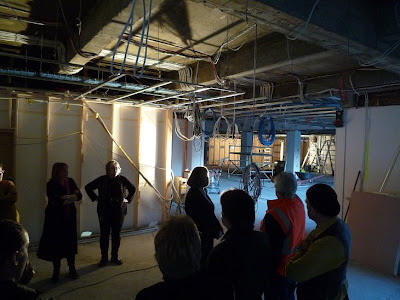
The entrance to the new staff area

The Morris Miller Librarian's Office

The new eLab 1, a combined teaching and student work space

The view from the Liaison Librarian's part of the new staff work area

This will be the new students area, for computers, and the reference and reserve collections

The entrance to the new staff area

The Morris Miller Librarian's Office

The new eLab 1, a combined teaching and student work space

The view from the Liaison Librarian's part of the new staff work area
Friday, 11 June 2010
Librarianship on iTunesU

I've been downloading a variety of stuff from iTunesU for a while, and it's just incredible what is available. Whole course lecture series from the world's great Universities, guest lecturers that are the top names in their fields and all kinds of other stuff, and all for free.
I only thought to look for librarianship content recently though, and while there's not as much as if you're interested in learning about some other subject areas, there is still enough content to keep you busy for quite a while.
For more on how to access iTunesU and what's available, check out the link below:
http://www.apple.com/education/itunes-u/whats-on.html
Tuesday, 25 May 2010
Rethink! Learning styles debunked
Rethink! Learning styles debunked
Latest research now contradicts long held beliefs about different learning styles and utilising them to create the best learning environment. Find out more about learning styles and see where you sit in this debate.
http://www.sciencedaily.com/releases/2009/12/091216162356.htm
Latest research now contradicts long held beliefs about different learning styles and utilising them to create the best learning environment. Find out more about learning styles and see where you sit in this debate.
http://www.sciencedaily.com/releases/2009/12/091216162356.htm
Monday, 24 May 2010
In Praise of Librarians
From a professor of English, a nice article for the start of the week.
Selected quotes below (but do read the whole article, it's well considered in its positivity about our work).
"highly professional guides who can lead us through an increasingly tangled bank of information, librarians provide a voice of caution in a period when drastic, irreversible change seems like an easy fix for a concatenation of expensive institutional ailments."
"In my experience, librarians almost always pass the beer test: They are among the most likeable people you'll find at any college. They have the intellectual curiosity of academics without the aloofness and attitude often displayed by professors. If you are a stranger on a strange campus, the one person who will always save you is a librarian. "
"...libraries are becoming "the new village green." Far from being the declining years of these revered institutions, the present offers new opportunities for collaboration and democratization with the library—and librarians—at the center of that experience."
http://chronicle.com/article/Marian-the-Cybrarian/65570/
Selected quotes below (but do read the whole article, it's well considered in its positivity about our work).
"highly professional guides who can lead us through an increasingly tangled bank of information, librarians provide a voice of caution in a period when drastic, irreversible change seems like an easy fix for a concatenation of expensive institutional ailments."
"In my experience, librarians almost always pass the beer test: They are among the most likeable people you'll find at any college. They have the intellectual curiosity of academics without the aloofness and attitude often displayed by professors. If you are a stranger on a strange campus, the one person who will always save you is a librarian. "
"...libraries are becoming "the new village green." Far from being the declining years of these revered institutions, the present offers new opportunities for collaboration and democratization with the library—and librarians—at the center of that experience."
http://chronicle.com/article/Marian-the-Cybrarian/65570/
Tuesday, 18 May 2010
More on the Google Books Settlement
Publishing executive turned industry consultant Michael Cairns has prepared a useful report which makes some well informed predictions about how the Google books project might play out, particularly interesting from our perspective are the predictions on pricing and how important the product might become for academic and research libraries.
If you're not up to date with what the Google Books settlement is, the the first couple of pages of the report are an excellent synopsis of the background and legal issues at stake.
Summary Findings of the Report:
* Libraries will see tremendous advantages – both immediate and over time - from the GBS, although concerns have been voiced (notably from Robert Darnton of Harvard)
* Google’s annual subscription revenue for licensing to libraries could approach $260mm by year three of launch
* Over time, publishers (and content owners) will recognize the GBS service as an effective way to reach the library community and are likely to add titles to the service
* Google will add services and may open the platform for other application providers to enhance and broaden the user experience
* The manner in which the GBS deals with orphan works will provide a roadmap for other communities of ‘orphans’ in photography, arts, and similar content and intellectual property
http://personanondata.blogspot.com/2010/04/database-of-riches-business-model.html
If you're not up to date with what the Google Books settlement is, the the first couple of pages of the report are an excellent synopsis of the background and legal issues at stake.
Summary Findings of the Report:
* Libraries will see tremendous advantages – both immediate and over time - from the GBS, although concerns have been voiced (notably from Robert Darnton of Harvard)
* Google’s annual subscription revenue for licensing to libraries could approach $260mm by year three of launch
* Over time, publishers (and content owners) will recognize the GBS service as an effective way to reach the library community and are likely to add titles to the service
* Google will add services and may open the platform for other application providers to enhance and broaden the user experience
* The manner in which the GBS deals with orphan works will provide a roadmap for other communities of ‘orphans’ in photography, arts, and similar content and intellectual property
http://personanondata.blogspot.com/2010/04/database-of-riches-business-model.html
Tuesday, 13 April 2010
The iPad
 (With optional keyboard)
A lot of talk around the web about the iPad at the moment, especially from librarians interested in technology. Reactions seem to range from desire to disgust, but there's always those who will complain about a new product and how it doesn't fit their lives (and extrapolate that no one else will want one).
NCSU libraries are lending them to students and I can see this becoming a trend, much easier to manage than a laptop, although I am sure they will have their own issues.
I feel pretty confident in forecasting that the iPad will have a similar impact in the eBook reader and portable computing device marketplace that the iPhone has had in the smart phone market, really setting the usability standard and being the most desirable and functional option for most people.
As a device for University students it won't replace a laptop or computer for all uses, but imagine only having to carry an iPad onto campus, with all your text books loaded, basic note taking and document layout programs, email and web browsing (and as many games as you could ever use) this is going to be very attractive for both publishers, students and teachers I think.
So, what about libraries? How can we use this new platform to deliver resources in a better way for students?
Friday, 9 April 2010
Demonstrating value
Stephen Abram has a good post about the value of academic libraries, it's a kind of mini literature review with many useful papers and websites.
It is an important area for us as the idea that "everything can be found on google so why do we need libraries?" becomes more prevalent (even among some librarians).
http://stephenslighthouse.com/2010/04/07/value-of-academic-and-college-libraries/
It is an important area for us as the idea that "everything can be found on google so why do we need libraries?" becomes more prevalent (even among some librarians).
http://stephenslighthouse.com/2010/04/07/value-of-academic-and-college-libraries/
Subscribe to:
Posts (Atom)


